
If you’ve typed “disregulated” into a search bar and wondered whether you spelled it right, you’re not alone. Thousands of people search this exact question every month, especially when reading about ADHD, trauma, or emotional health. The two words look almost identical, sound similar out loud, and get swapped constantly in blog posts, therapy sessions, and casual conversation.
Only one of them, though, is actually recognized in standard English. This guide breaks down the real difference, explains where the confusion comes from, and shows you exactly which word to use in every situation.
Quick Answer
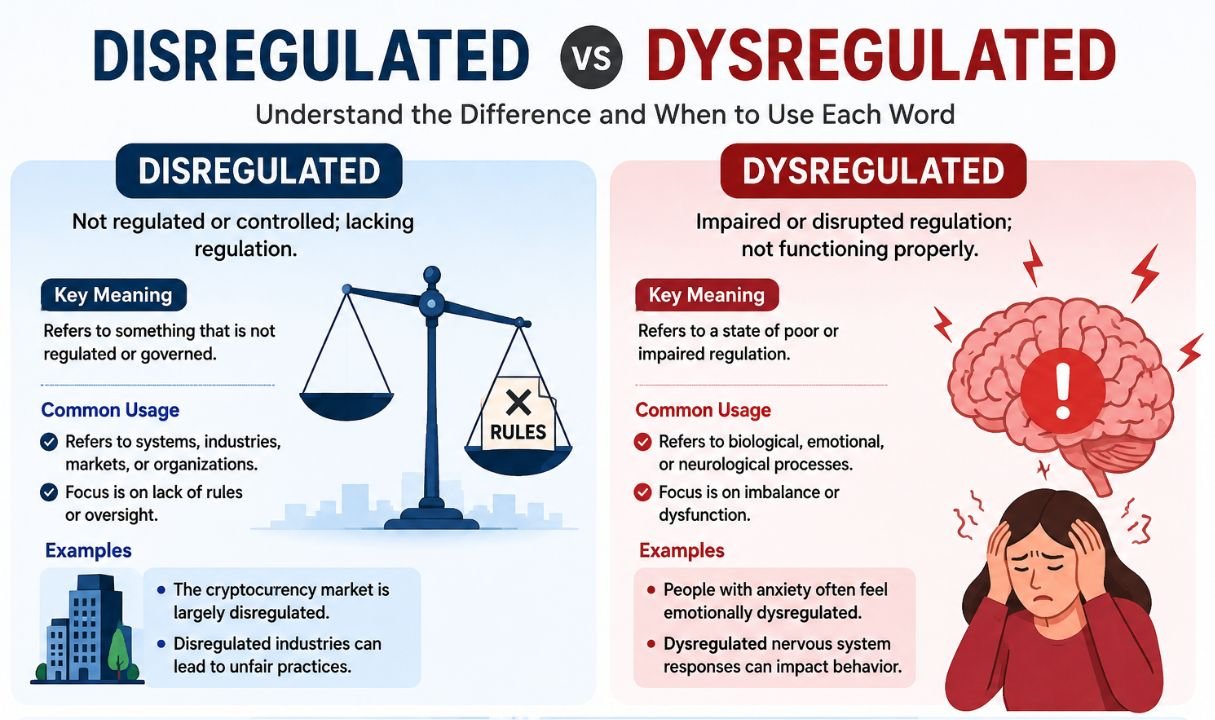
Dysregulated is the correct, dictionary-recognized word. It describes a system, emotion, or bodily process that has lost its normal ability to regulate itself.
Disregulated is not a standard English word. It shows up in casual writing and social media, but professionals in medicine, psychology, and education almost never use it.
Examples
- Correct: “His nervous system felt dysregulated after the stressful meeting.”
- Incorrect: “His nervous system felt disregulated after the stressful meeting.”
Disregulated vs Dysregulated Meaning
Dysregulated Meaning
Dysregulated describes something that used to function normally, or should function normally, but has fallen out of balance. It applies to emotions, hormones, behavior, and biological systems. The word points to impaired control rather than a total absence of control.
Example Sentences
- Children with ADHD often show dysregulated behavior during transitions between activities.
- Chronic stress can leave cortisol levels dysregulated for months at a time.
- Her sleep-wake cycle became dysregulated after weeks of night shifts.
Disregulated Meaning
Disregulated is a spelling error, not a separate word with its own meaning. Some dictionaries list it as a rare or nonstandard variant, but the vast majority treat it as a simple misspelling of dysregulated. It likely spread because “dis-” is such a common English prefix.
Example
- “She said her emotions felt disregulated” is grammatically understandable but not considered correct usage in professional or academic writing.
Disregulated vs Dysregulated Difference
| Feature | Dysregulated | Disregulated |
|---|---|---|
| Standard English | Yes | No |
| Prefix | dys- (impaired, abnormal) | dis- (removal, absence) |
| Used in medical/psychology fields | Yes, widely | Rarely, considered incorrect |
| Dictionary status | Recognized | Not officially recognized |
| Common context | Emotions, biology, behavior | Informal writing, typos |
Key Point
The single letter separating these words changes their entire meaning. “Dys-” signals that a system is working poorly. “Dis-” signals that something has been taken away entirely. A regulated system that starts malfunctioning is dysregulated, not disregulated.
You May Like: Nosey or Nosy | Guide With Grammar Rules, Examples, and Common Mistakes for 2026
The Origin of Dysregulated
Dys
The prefix “dys-” comes from Greek and means bad, abnormal, or difficult. It shows up across medical and scientific vocabulary to describe things that don’t work the way they’re supposed to.
Examples
- Dysfunction
- Dyslexia
- Dysphoria
- Dystrophy
Regulated
“Regulated” comes from the Latin root “regula,” meaning rule. A regulated system follows a consistent, controlled pattern, whether that’s a hormone cycle, a heart rate, or an emotional response.
Combined Meaning
Put “dys-” and “regulated” together, and you get a word describing a system whose normal rules of control have broken down. It’s not gone. not switched off. It’s simply operating outside its expected pattern.
Why People Write Disregulated Instead of Dysregulated
Most English speakers meet the prefix “dis-” far more often than “dys-.” Words like disconnect, disagree, and disorganized are part of everyday vocabulary, so the brain defaults to a familiar pattern when spelling an unfamiliar term.
Common Dis Prefix Examples
- Disconnect
- Disorganized
- Disorderly
- Disengage
- Disable
Because these words are so common, “disregulated” feels like a natural guess, even though it isn’t grammatically accurate.
Grammar Rule Depth
The Prefix Dis
“Dis-” typically means to remove, reverse, or negate something entirely. To disconnect is to remove a connection. To disengage is to stop being engaged. The action implies a full stop, not partial impairment.
The Prefix Dys
“Dys-” means something is functioning badly or abnormally, not that it has stopped functioning. A dysfunctional process still runs. It just runs poorly.
Important Difference
Regulation is an active, ongoing process in the body and mind, not something that gets fully switched off. Since the word needs to describe impaired function rather than complete removal, “dys-” is the linguistically correct choice, and “dis-” simply doesn’t fit the concept.
Dysregulated in Psychology
Emotional Dysregulation
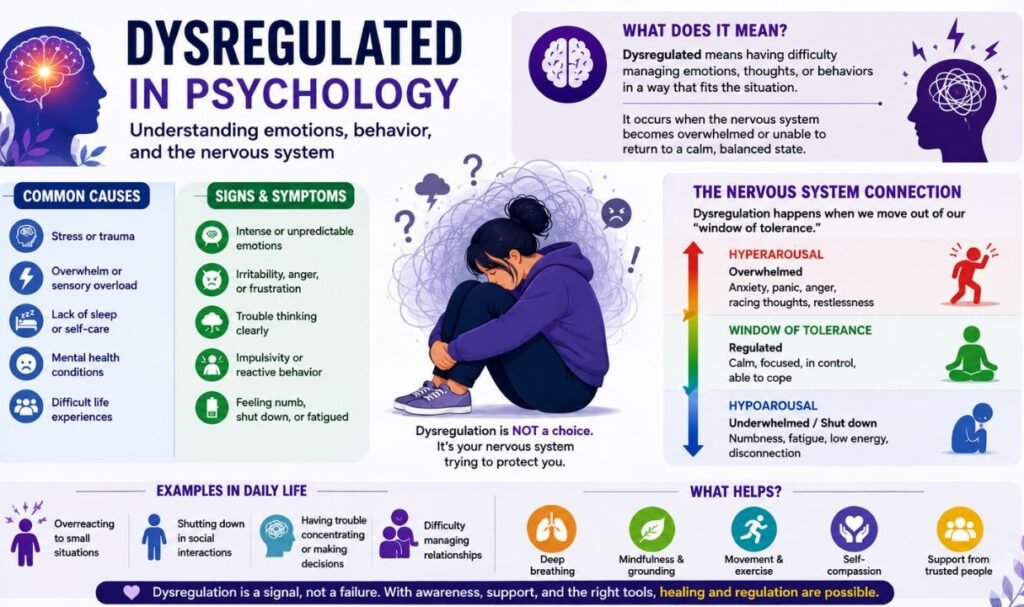
Emotional dysregulation refers to difficulty managing the intensity or duration of emotional responses. People experiencing it may react more strongly than a situation calls for or struggle to calm down once upset.
Example
A person with emotional dysregulation might feel calm one moment and overwhelmed with anger the next, with little warning in between.
Behavioral Dysregulation
This term describes impulsive or inconsistent behavior patterns that make it hard to follow routines, manage reactions, or respond appropriately to feedback. It’s often discussed alongside ADHD, autism, and certain mood disorders.
Dysregulated in Medicine
Nervous System Dysregulation
A dysregulated nervous system struggles to shift smoothly between calm and alert states. This shows up in conditions linked to chronic stress, trauma, and some anxiety disorders.
Hormonal Dysregulation
Hormones follow tightly controlled release patterns. When that pattern breaks down, doctors describe it as hormonal dysregulation, which can affect everything from metabolism to mood.
Immune System Dysregulation
An immune system that overreacts or underreacts to threats is considered dysregulated. This concept appears frequently in research on autoimmune conditions and chronic inflammation.
Examples
- Dysregulated blood sugar levels in diabetes
- Dysregulated thyroid hormone production
- Dysregulated inflammatory response after injury
Dysregulated in Everyday Language
Social Media
Mental health creators on platforms like Instagram and TikTok use “dysregulated” constantly when discussing nervous system health, trauma responses, and emotional coping strategies.
Blogs and Self Help Content
Wellness writers lean on the term to describe stress responses, burnout, and emotional overwhelm in a way that feels clinical but accessible.
Parenting Discussions
Parents and educators use “dysregulated” to describe meltdowns, tantrums, or moments when a child can’t calm down through normal means.
Real World Usage Examples
In Therapy
A therapist might describe a client’s fight-or-flight response as dysregulated when it activates too easily or stays active for too long.
In Healthcare
A physician might note dysregulated glucose levels on a patient chart to describe unstable blood sugar readings.
In Education
A teacher might describe a student as dysregulated after recess, referring to difficulty settling back into classroom routines.
In Workplace Discussions
An HR professional might reference a dysregulated stress response when discussing burnout prevention with staff.
You May Like: Planning vs Planing: Definition, Usage, and Real-Life Examples
British English vs American English Usage
There is no meaningful spelling difference between British and American English here. Both dialects treat “dysregulated” as the standard term and “disregulated” as an error. Unlike words such as “colour” versus “color,” this isn’t a regional spelling variation.
Key Point
If a British publication uses “disregulated,” it’s a mistake, not a regional preference.
Which Spelling Should You Use
Use Dysregulated When
- Writing about emotions, behavior, or biology
- Producing academic, medical, or professional content
- Discussing psychology, trauma, or child development
- You want your writing to read as accurate and credible
Avoid Disregulated When
- Writing for publication, especially formal or scientific content
- Submitting academic papers or clinical notes
- Trying to sound informed about mental health topics
- Any context where precision matters
Common Mistakes with Disregulated or Dysregulated
Mistake 1: Using Disregulated in Professional Writing
This is the most frequent error. Writers who aren’t familiar with the “dys-” prefix default to the more common “dis-” spelling, which weakens credibility in formal contexts.
Mistake 2: Assuming Both Words Are Equal
Some assume the two spellings are interchangeable variants, similar to “gray” and “grey.” They aren’t. Only one is recognized as standard.
Mistake 3: Misunderstanding the Prefix
Confusing “dys-” with “dis-” leads to broader misunderstandings about what the word actually communicates: impaired function, not a total loss of function.
Dysregulated in Emotional Health
Emotional Dysregulation Symptoms
- Sudden mood swings
- Difficulty calming down after being upset
- Overreacting to minor stressors
- Trouble identifying or naming feelings
- Impulsive reactions under stress
Example
Someone with emotional dysregulation might snap at a coworker over a small comment, then feel confused about why the reaction was so intense.
Dysregulated in Child Development
Common Signs
- Meltdowns that seem disproportionate to the trigger
- Difficulty transitioning between activities
- Trouble self-soothing without adult support
- Sensory sensitivities that spark big reactions
Example
A dysregulated child at a birthday party might go from excited to inconsolable within minutes, overwhelmed by noise and stimulation.
Dysregulated in Trauma Discussions
Trauma-informed care frequently references a dysregulated nervous system to describe how past experiences can leave someone stuck in heightened alertness or shutdown states, even when there’s no current threat.
Example
A trauma survivor might feel their body go into a dysregulated state during an ordinary disagreement, reacting as though facing real danger.
Dysregulated in Neuroscience
Neuroscientists use “dysregulated” to describe brain activity or neurotransmitter levels that fall outside typical ranges. This includes dysregulated dopamine signaling, which researchers connect to attention and reward-processing differences, and dysregulated cortisol rhythms tied to chronic stress.
Brain Function
A dysregulated brain doesn’t stop functioning. It processes information and emotion in ways that don’t match expected patterns, which can affect focus, memory, and mood stability.
Example
Researchers studying dysregulated vs disregulated in adults with ADHD consistently use the “dys-” spelling in published studies, reinforcing it as the accepted clinical term. The same holds true across research on dysregulated vs dysregulated child behavior, dysregulated nervous system responses, and comparisons like dysregulated vs unregulated or dysregulated vs deregulated, where each term carries a distinct meaning tied to how a system was originally controlled.
Related Words and Similar Terms
Related Terms
- Dysfunction
- Dysfunctional
- Dysregulation
- Deregulate
- Unregulated
Similar Concepts
“Unregulated” describes something that was never controlled in the first place. “Deregulated” refers to rules or restrictions being formally removed, often in a legal or economic sense. Neither word is a substitute for “dysregulated,” which specifically points to a system that should be self-regulating but currently isn’t.
Why Dysregulated Became Popular
Interest in mental health and trauma-informed care has grown steadily over the past decade, and “dysregulated” gives people a precise way to describe emotional and physiological states without relying on vaguer terms like “upset” or “off.” Its rise mirrors a broader shift toward clinical vocabulary entering mainstream conversation, much like “triggered” or “burnout” did before it.
Dysregulated in Formal Writing
Academic Example
“Participants exhibiting dysregulated cortisol responses showed higher rates of reported anxiety.”
Healthcare Example
“The patient presented with a dysregulated heart rate following the procedure.”
Therapy Example
“Today we’ll focus on grounding techniques to help calm your dysregulated nervous system.”
Dysregulated in Social Media and Online Discussions
Example Posts
- “My nervous system has been so dysregulated this week, I can barely focus.”
- “Reminder that a dysregulated kid isn’t a bad kid, they just need support.”
- “Learning to notice when I’m dysregulated has changed how I handle conflict.”
Usage Trends and Language Data
Search interest in both spellings has climbed alongside growing public interest in trauma, ADHD, and emotional regulation content. However, published books, journal articles, and clinical resources overwhelmingly favor “dysregulated,” reinforcing its status as the standard term across formal and semi-formal writing alike.
Exercise 1: Choose the Correct Word
- Her emotions felt completely ______ after the argument. (dysregulated / disregulated)
- Chronic stress can leave the body’s hormone levels ______. (dysregulated / disregulated)
- The child’s behavior became ______ after skipping his nap. (dysregulated / disregulated)
(Answer: dysregulated for all three.)
Exercise 2: Correct the Sentence
- Incorrect: “His stress response felt totally disregulated by Friday.”
- Correct: “His stress response felt totally dysregulated by Friday.”
Frequently Asked Questions
Is it spelled dysregulated or disregulated?
Dysregulated is the correct spelling. Disregulated is a common misspelling with no standard dictionary recognition.
What does it mean to be disregulated?
It’s typically meant as “dysregulated,” describing an emotional, behavioral, or biological system that isn’t functioning normally.
Is it unregulated or disregulated?
Neither is interchangeable with dysregulated. Unregulated means something was never controlled, while dysregulated means normal regulation has broken down.
Is it disregulated or dysregulated in the UK?
Dysregulated is correct in both UK and US English. There’s no regional spelling difference for this word.
Conclusion
The confusion between disregulated and dysregulated comes down to one letter with a significant impact on meaning. Dysregulated describes a system, emotion, or process that isn’t working the way it should, and it’s the term recognized across medicine, psychology, and everyday professional writing. Disregulated, while a common typo, isn’t standard English and can quietly undercut the credibility of your writing.