
Have you ever typed a sentence, paused, and stared at the word “eaten” wondering if it should actually be “aten”? You are not alone. This mix-up shows up in text messages, school essays, and even professional emails. The good news is that the answer is short and the reasoning behind it is even shorter. This guide walks through the correct spelling, the grammar rule behind it, and the small habits that will stop this mistake for good.
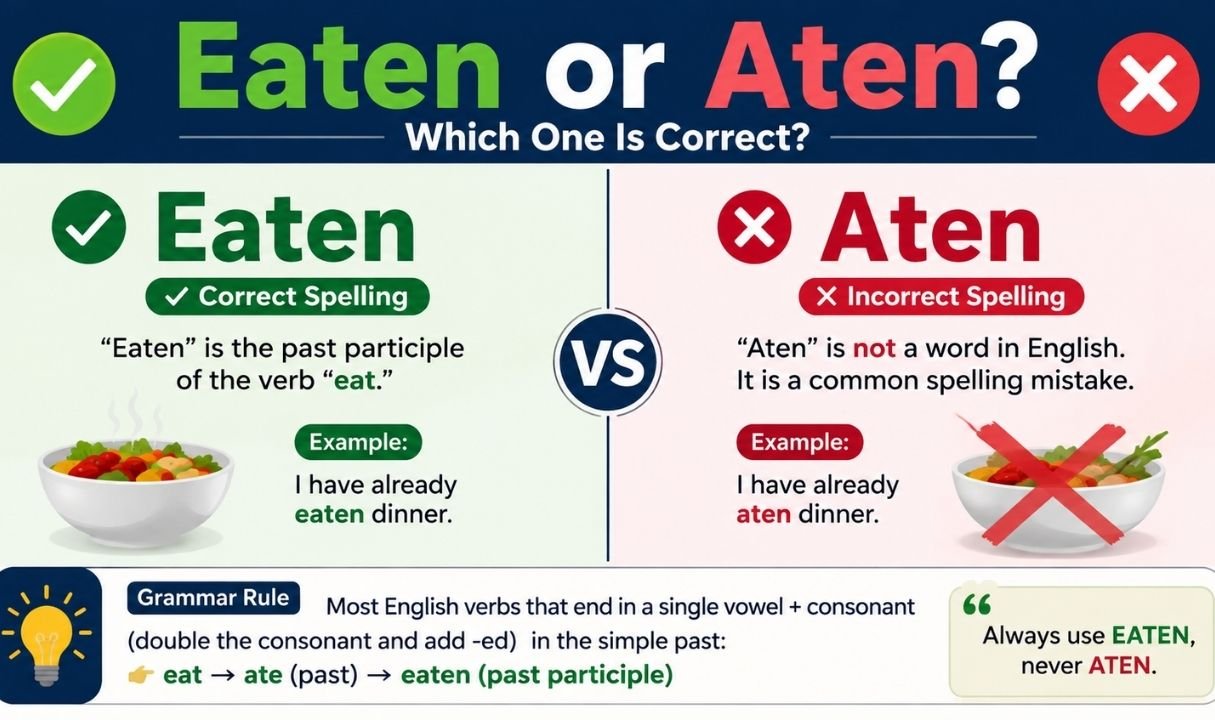
Eaten or Aten – Quick Answer
Eaten is correct. Aten is not a word in standard English.
There is no debate here, no regional exception, and no informal version where “aten” becomes acceptable. Every major dictionary, grammar guide, and style manual lists eaten as the past participle of the verb eat. Aten simply does not appear as an alternative spelling anywhere in English grammar references.
Here is the short version:
- Eat → present tense (I eat breakfast every day)
- Ate → simple past tense (I ate breakfast an hour ago)
- Eaten → past participle, used with helping verbs (I have eaten breakfast)
If your sentence contains “have,” “has,” “had,” “was,” “were,” or “been,” the word you need is eaten. If you write aten in that spot, it will read as a spelling error to anyone who knows English grammar, including spell-checkers, teachers, and hiring managers.
What Do Eaten and Aten Mean?
Eaten
Eaten describes the completed act of consuming food, and it can also be used more broadly for anything that has been consumed, worn away, or used up. It is the third form of the verb eat, sitting alongside eat and ate in the verb’s full set.
A few quick examples:
- She has eaten already, so she isn’t hungry.
- The cake was eaten before the party even started.
- Rust had eaten through the old pipe.
Notice that eaten never stands alone in a sentence. It leans on a helping verb such as have, has, had, is, was, or been to form a complete thought.
Aten
Aten has no meaning as a verb form in English. If you search dictionaries expecting a definition tied to eating, you won’t find one. The only legitimate appearance of “Aten” in the English language is as a proper noun: the ancient Egyptian sun disk deity worshipped during the reign of Pharaoh Akhenaten. That word is capitalized, refers to a specific historical and religious figure, and has nothing to do with food or the verb eat.
So when someone types “I have aten dinner,” they are not using an alternate spelling. They are producing a word that does not belong in that sentence at all.
The Verb Forms of “Eat”
English irregular verbs rarely follow the predictable “add -ed” pattern, and eat is a textbook example. Instead of eat, eated, eated, the verb shifts shape entirely across its three main forms.
| Form | Word | Example |
|---|---|---|
| Base form | Eat | I eat lunch at noon every day. |
| Simple past | Ate | I ate lunch an hour ago. |
| Past participle | Eaten | I have eaten lunch already. |
A simple way to remember the pattern: the base form and the past participle both end differently from what you’d expect, and the middle form, ate, never appears next to a helping verb. If you catch yourself writing “have ate” or “had ate,” that’s your signal to switch to eaten.
The Origin of Eaten or Aten
The spelling “aten” has never existed as a recognized past participle in English. Its appearance in everyday writing comes almost entirely from how the word eaten sounds in fast, casual speech. When people talk quickly, the “ee” sound at the start of eaten can flatten out, making it sound closer to “ay-tin,” which is easy to mistype as aten once someone sits down to write it out.
This is a pronunciation-driven error rather than a spelling variation, a regional dialect, or an older form of the word that fell out of use. Old English and Middle English texts show early spellings of eat’s past participle such as “eten,” but none of these historical forms match “aten” either.
Because so many people run into this same confusion, a cluster of related questions shows up again and again in search results:
- Eaten or aten past tense – Eaten is not the past tense at all; it’s the past participle. Ate handles the simple past tense.
- Eaten or aten grammar – Grammar rules only recognize eaten. Aten is never grammatically valid.
- Is aten a word for food – No. Aten is not connected to food, meals, or consumption in any dictionary sense.
- Eaten or aten examples – Every correct example uses eaten (I have eaten, she has eaten, they had eaten).
- Eaten pronunciation – Eaten is pronounced EE-tn, with the emphasis on the first syllable.
- Is eaten a word – Yes, eaten is a standard English word and the correct past participle of eat.
- Have you eaten or ate – “Have you eaten?” is correct. “Have you ate?” breaks the rule that helping verbs pair with past participles, not simple past forms.
British English vs American English Spelling
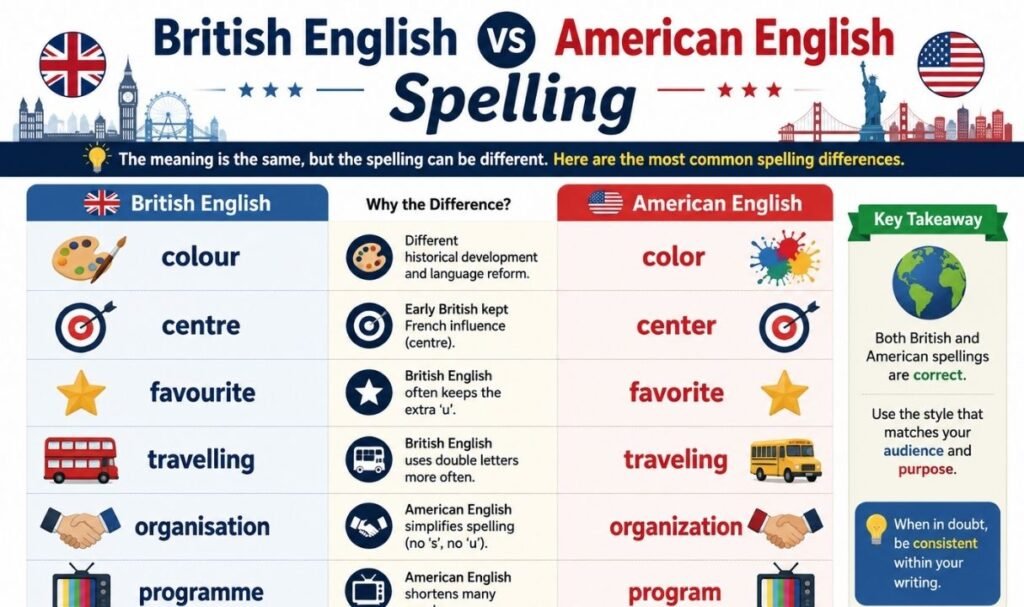
One reason people question whether aten might be a regional spelling is that British and American English do differ on plenty of words: colour versus color, organise versus organize, travelled versus traveled. It’s a reasonable guess, but it doesn’t apply here.
Eaten is spelled and used the exact same way in both British and American English. There is no British form that swaps in an “a,” no American shortcut, and no dialect that officially recognizes aten as valid. Regional differences in English tend to involve extra letters, different suffixes, or swapped vowels within an already-established word, not an entirely separate root spelling for a common verb form.
Comparison Table
| Feature | British English | American English |
|---|---|---|
| Past participle of eat | Eaten | Eaten |
| Simple past of eat | Ate | Ate |
| Pronunciation | EE-tn | EE-tn |
| Formal usage | Requires helping verb | Requires helping verb |
| Is “aten” accepted? | No | No |
Which Spelling Should You Use?
Always use eaten. There is no context, audience, or writing style where aten is the better or even acceptable choice. Whether you’re drafting a college essay, replying to a coworker, writing a novel, or texting a friend, eaten is the only correct option.
If you’re ever unsure mid-sentence, run this quick check:
- Look for a helping verb nearby (have, has, had, was, were, been).
- If one is present, the verb you need is the past participle: eaten.
- If there’s no helping verb and you’re describing a single completed past action, use ate instead.
- If neither fits and you’re describing a present, repeated, or habitual action, use eat.
This three-step check works for almost every sentence you’ll come across.
Common Mistakes with Eaten or Aten
Writing “aten” instead of “eaten”
This is the most frequent error, and it almost always traces back to how the word sounds rather than a genuine belief that aten is a real word. Reading your sentence out loud slowly, rather than at conversational speed, usually catches this instantly.
Using “eaten” without a helping verb
Eaten cannot stand on its own as a main verb. A sentence like “I eaten breakfast” is incomplete and incorrect. It needs a partner: “I have eaten breakfast” or “I had eaten breakfast before leaving.”
Mixing up “ate” and “eaten”
Because both words describe the past, writers often swap them without noticing. The test is simple: if there’s a helping verb in the sentence, eaten is required. Without one, ate does the job. “I have ate” and “I had ate” are both incorrect; “I have eaten” and “I had eaten” are the versions grammar rules call for.
Eaten or Aten in Everyday Examples
Emails
Work emails often use the present perfect or past perfect tense when referencing meals, deadlines, or completed tasks tied to a broader timeline.
- “By the time you arrive, I will have eaten lunch.”
- “The team hasn’t eaten since the meeting started.”
News
News writing frequently uses eaten in passive constructions, especially in stories about food safety, wildlife, or health.
- “The contaminated batch had already been eaten by dozens of customers before the recall.”
- “Officials confirmed the crops were eaten by an unusually large swarm of locusts.”
Social Media
Casual posts still follow the same grammar rule, even with shorter, less formal phrasing.
- “Already eaten, no more room for dessert 😅”
- “Have you eaten yet? Grabbing food in 10.”
Formal Writing
Academic and clinical writing relies on precise verb tenses to describe sequences of events accurately.
- “Participants had eaten a standardized meal two hours before testing began.”
- “The subjects reported having eaten breakfast on the morning of the assessment.”
Why People Get Confused Between Eaten and Aten
A few overlapping reasons explain why this particular mix-up is so common:
- Speech patterns blur the vowel sound. Fast, casual speech softens “eaten” enough that it can sound like “aten” to the ear, especially to non-native speakers still building their listening skills.
- Irregular verbs resist logic. English learners naturally expect a pattern, and when eat doesn’t follow the “add -ed” rule the way walk or talk does, guessing becomes tempting.
- Autocorrect doesn’t always catch it. Some spell-checkers flag aten immediately, but others, particularly in casual messaging apps, let it slide through without a red underline.
- No one explains the “why.” Many people memorize that eaten is correct without understanding that it pairs specifically with helping verbs, so the rule doesn’t stick as firmly as it should.
- Visual similarity to ate. Since aten looks like a natural extension of ate with an extra letter tacked on, it can feel like a logical guess even though English doesn’t build the past participle that way.
Once the underlying verb pattern clicks, most people stop making this mistake entirely, because they’re no longer guessing based on sound. They’re applying a rule.
Eaten or Aten – Search Trends and User Intent
Search data around this phrase points to a consistent pattern: people typing “eaten or aten” are almost never confused about what the word means. They already understand the concept of having consumed food. What they want is spelling confirmation, usually while writing something in real time, whether that’s a text message, an assignment, or a work document.
This intent shows up across a wide range of searchers, including:
- Students checking grammar before submitting assignments
- Non-native English speakers building confidence with irregular verbs
- Writers, bloggers, and editors double-checking word choice
- Parents helping kids with homework
- Professionals reviewing emails or reports before sending them
The consistency of this pattern across different search platforms and regions suggests this is a universal spelling clarification, not a genuine grammatical gray area or dialect-based split. Once someone lands on a clear explanation with the correct answer and a short reason why, the search intent is fully satisfied.
Comparison Table: Eaten vs Aten
| Category | Eaten | Aten |
|---|---|---|
| Part of speech | Past participle of “eat” | Not a standard English word |
| Correct usage | I have eaten, she had eaten | Not applicable |
| Meaning | Consumed, finished eating | No verb meaning; proper noun only (Egyptian sun deity) |
| Requires helping verb | Yes | N/A |
| Recognized in dictionaries | Yes | No, except as the proper noun “Aten” |
| Regional variation | None; same in British and American English | None; never correct in any variety of English |
| Common in formal writing | Yes | Never |
Frequently Asked Questions
Is aten a word for eating?
No. Aten has no connection to eating in standard English; the correct past participle is eaten.
Is the word “aten” a word?
As a lowercase verb form, no. Capitalized, “Aten” exists only as the name of an ancient Egyptian sun deity.
Do we say “eaten”?
Yes, eaten is the correct past participle of eat and is used constantly with helping verbs like have, has, and had.
Is “eaten” a correct term?
Yes, eaten is fully correct and standard in both British and American English.
Conclusion
The choice between eaten or aten isn’t really a choice at all once you know the rule. Eaten is the only correct spelling, aten holds no meaning tied to food or the verb eat, and the confusion almost always traces back to how quickly we speak rather than any real gap in English grammar.
Keep an eye out for helping verbs like have, has, and had, pair them with eaten, and this mistake won’t trip you up again, whether you’re writing a quick text or a formal report.